
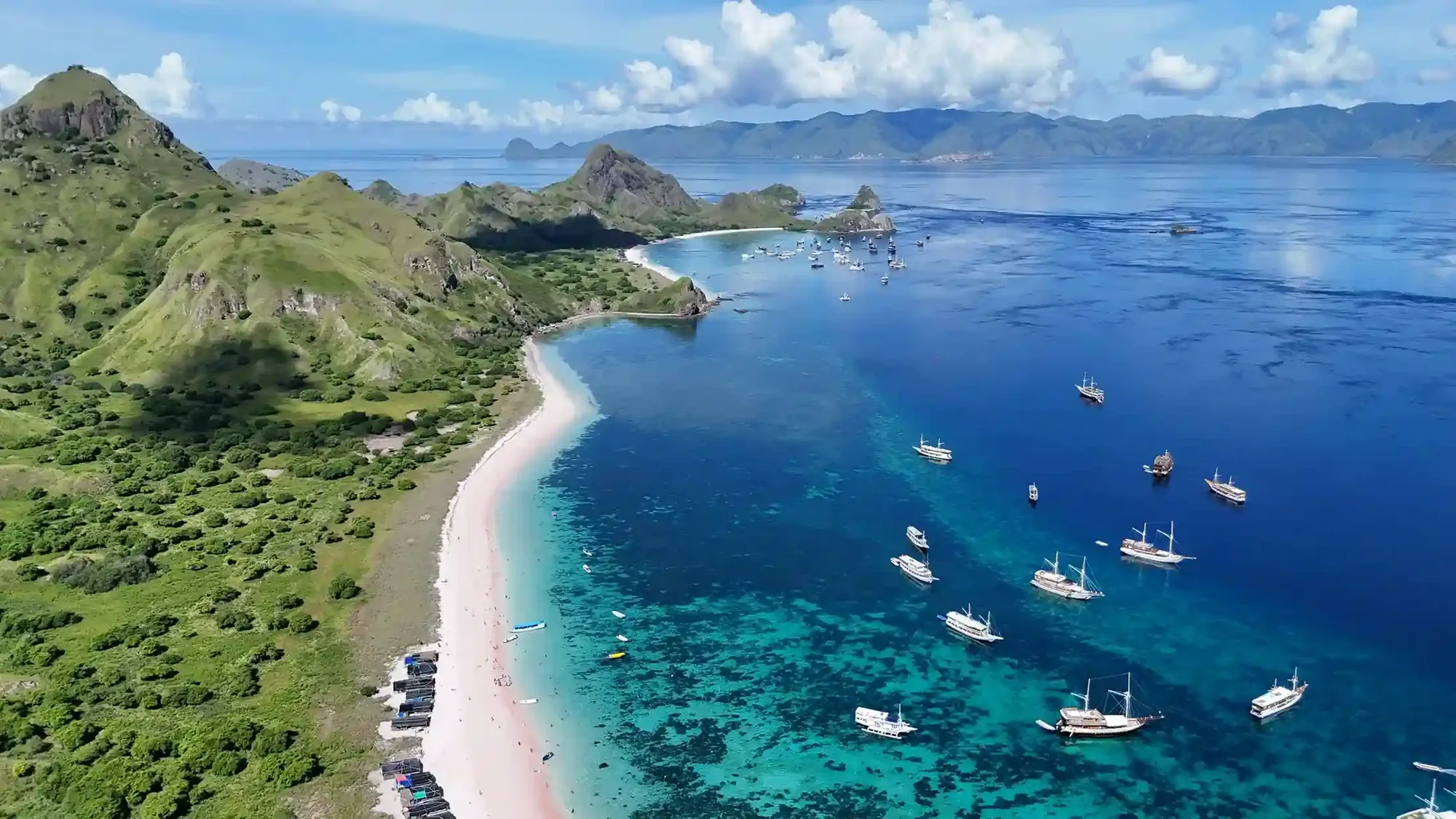
Short answer. Pink Beach, known locally as Pantai Merah, gets its colour from red-shelled foraminifera and fragments of red organ-pipe coral mixed into white coral sand. The pink reads strongest at the waterline, in early or late light, and after the sand has been wetted by a wave.
Pink Beach is either a highlight or a mild disappointment, and which one you get is almost entirely down to timing and expectation. Nobody’s Instagram tells you that the colour is subtle, that it is strongest in a wet band at the water’s edge, and that at noon under flat light the whole thing reads as pale cream.
What makes the sand pink?
Two contributors, mixed into ordinary white coral sand. The main one is foraminifera: single-celled marine organisms that build shells, some species of which are strongly red or pink. When they die, the shells break down and the fragments join the sand. The second is crushed red coral, including organ-pipe coral, washed onto the beach from the fringing reef just offshore.
The result is a blend rather than a uniform colour. Scoop a handful and you can see the individual red grains among the white. That is the honest photograph, and it is more interesting than the wide shot.
| Factor | Effect on the colour |
|---|---|
| Time of day | Early morning and late afternoon light saturate the pink; midday flattens it |
| Wet versus dry sand | The wet band at the waterline is markedly stronger than dry sand higher up |
| Recent weather | Fresh wave action turns over sand and brings up more red fragments |
| Where you stand | The colour concentrates in patches, not evenly along the whole beach |
| Your camera | Phone auto white balance often corrects the pink away; lock it manually |
When should you go?
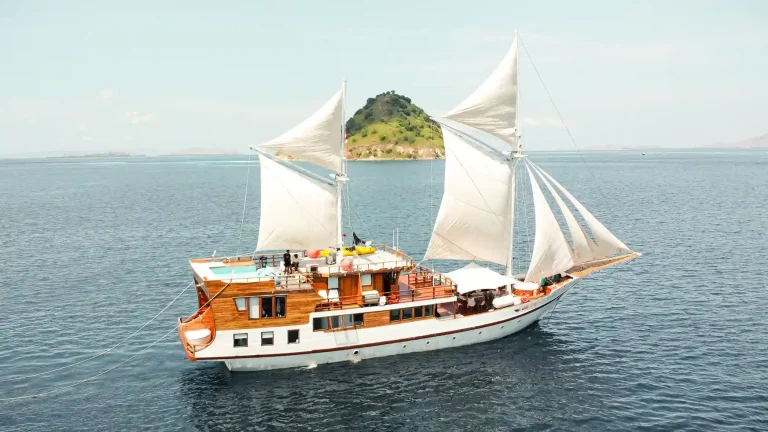
Early. On the published Lady Grace three-day route, Pink Beach falls at around 09:00 on day two, straight after the Padar sunrise trek and breakfast, and before the Komodo Island ranger trek. That is a deliberate ordering: you arrive while the light is still low enough to be flattering and before the day boats out of Labuan Bajo reach the anchorage.
By late morning the beach carries a crowd, the light is overhead, and the colour is at its weakest. This is the same structural advantage that makes the Padar sunrise possible, and it is one of the strongest arguments for sleeping on the water. The full timetable is on the 3D2N itinerary and price page.
The snorkelling is the underrated part
Most visitors photograph the sand and get back in the tender. The fringing reef directly off the beach is genuinely good: hard and soft coral in shallow water, reef fish in quantity, and easy entry straight off the sand. It suits weaker swimmers because you can stand up, and it suits families for the same reason.
Snorkelling gear and life vests are on the operator’s published inclusion list, so there is nothing to rent and nothing to carry. Watch the current at the edges of the bay, stay inside the area the crew indicates, and keep fins clear of the coral — it is shallow enough that careless kicking does real damage. The wider water-focused itinerary is set out on the island-hopping and snorkelling page.
What not to take home
Removing sand, shells or coral from a national park is prohibited, and at Pink Beach it is also self-defeating: the beach is pink precisely because those fragments stay there. Bottles of pink sand have become a quiet problem at every coloured beach in the world, and the colour visibly fades where collection is heavy.
- Take photographs, not sand. A close-up of a wet handful shows the colour better anyway.
- Leave shells and coral fragments where they are.
- Carry your rubbish back to the boat; there are no bins.
- Use reef-safe sunscreen, and apply it before you get to the beach so it has time to bind.
- Wear something on your feet in the shallows; coral rubble is sharp.
Is it worth the stop?
Yes, with calibrated expectations. Pink Beach is one of a small number of beaches worldwide with this colouration, the reef offshore is excellent, and it sits on the natural line between Padar and Komodo Island so it costs you nothing in routing. Go in expecting a subtle blush rather than a bubblegum shoreline and you will enjoy it. Go in expecting the over-saturated version and you will be the person on the beach adjusting their photo editor.
Groups who want the anchorage to themselves for longer, or want to swim before the tender traffic starts, generally do better on a whole-boat booking where the schedule is theirs; the family and group charter page covers how that works. Alternative departures that include the same anchorage are listed among the fleet’s family-charter options.
Natural feature, natural variation. The intensity of the colour changes with light, weather, tide and how recently the sand has been turned over. Descriptions here reflect commonly documented conditions reviewed 31 July 2026, not a guarantee of what any single morning will look like.
Sailing with Lady Grace
Ask what time your departure reaches the Pink Beach anchorage on day two, and how long the crew plans to stay.
WhatsApp +62 811 3823 875 · [email protected]
Lady Grace is operated by Komodo Luxury in Labuan Bajo. Quotes, availability, deposit terms and cancellation terms are issued by the operator in writing before payment.