
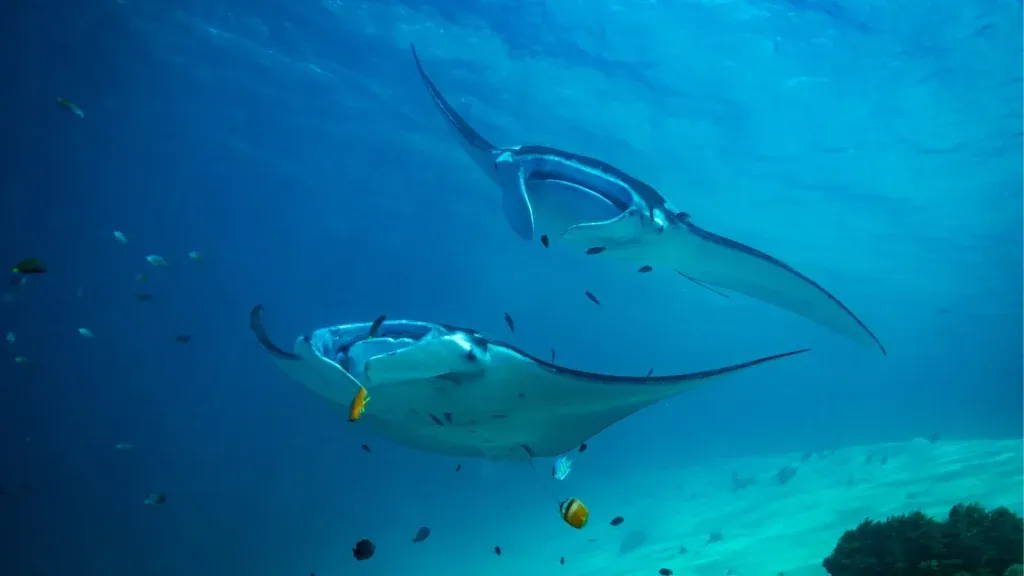
Short answer. Manta Point, properly called Karang Makassar, is a shallow drift site east of Komodo Island where reef manta rays feed and visit cleaning stations. Mantas are present all year, with peak numbers around December to March. You enter from a tender, drift with the current, and get collected downstream.
Of everything a Komodo itinerary promises, this is the stop people replay in their heads afterwards. It is also the stop most misunderstood before arrival, because the name suggests a fixed point and the reality is a moving river of water that you join and leave.
What is Karang Makassar?
Karang Makassar is a long, shallow coral rubble plateau in the channel between Komodo Island and the smaller islands to its east. Nutrient-rich water funnels through, plankton concentrates, and reef mantas arrive to feed and to be cleaned by resident wrasse. The topography is unremarkable to look at. The animals are not. Wingspans of three to four metres are routine, and mantas frequently pass within a few metres of a snorkeller who is doing nothing at all.
Because it is shallow, it is one of very few places in the world where snorkellers get an experience close to what divers get. You are not looking down through thirty metres of blue at a distant shape; the animal is often at arm’s length below the surface.
How does the drift actually work?
The current runs, and you run with it. The tender drops the group upstream, you float face down and let the water carry you across the plateau, and the tender picks you up at the far end. Trying to swim against the flow is exhausting and pointless, and it is the single most common beginner mistake. The crew brief will tell you which way the water is moving, where the pickup will be, and what to do if you get separated from the group.
| Element | What to expect |
|---|---|
| Entry | Backward or side roll from the tender, in a group, on the crew’s signal |
| Depth over the plateau | Shallow enough that mantas pass between you and the seabed |
| Current | Variable with tide; a genuine drift, not a swim |
| Duration of a pass | Typically one drift run, repeated if conditions and sightings allow |
| Pickup | Downstream by tender; stay grouped and stay visible |
| Gear | Snorkel set and life vest are on the operator’s published inclusion list |
The visibility trade-off nobody mentions
The plankton that draws the mantas is the same plankton that clouds the water. Peak season for numbers is roughly December to March, exactly when visibility drops to about 10 to 15 metres. In the dry season, visibility climbs to 20 to 30 metres but the aggregation thins. You cannot have both at maximum.
Most people who have done it twice recommend the shoulder months. May and October give you meaningful manta activity with water clear enough to photograph, which is a better outcome than a February encounter that is dense but grey. The month-by-month sea guide lays out the full seasonal picture if you are still choosing dates.
Manta etiquette, and why it is not optional
Reef mantas are curious and tolerant, and they leave when crowded. The rules that keep encounters long rather than brief are simple:
- Do not touch. Their skin carries a mucus layer that protects against infection.
- Do not chase. A manta that is approached head-on turns away; a manta passed calmly often circles back.
- Stay off the cleaning stations. If a manta is hovering over a coral head being cleaned, keep your distance and stay above, not on top of it.
- Do not dive down onto them. Descending vertically reads as a threat.
- Keep fins off the reef. The plateau is coral rubble and living structure, not sand.
- Follow the crew’s line. They know where the current sets and where the boat traffic is.
There is a practical selfish argument alongside the conservation one: the groups that behave well get the longer encounters. Every guide in Labuan Bajo will tell you the same thing.
Where it falls on a Lady Grace itinerary
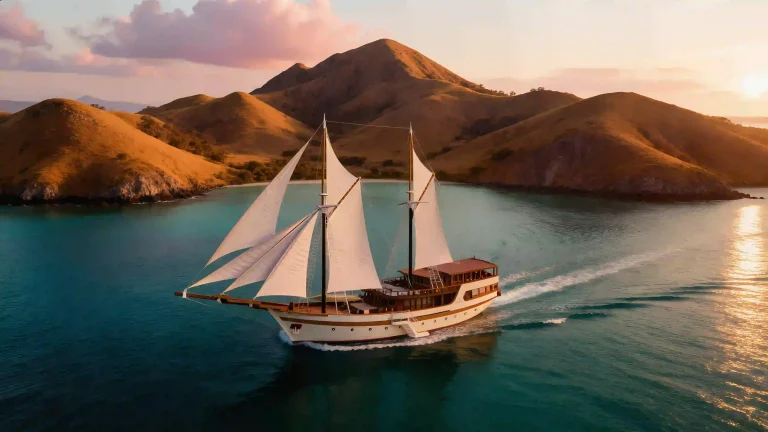
On the published three-day, two-night route, Manta Point sits on day two at around 14:30, after the Komodo Island ranger trek and lunch, and before Taka Makassar in the late afternoon. Times shift with tide, swell and ranger scheduling; the crew will move the stop if the current is wrong. Full timings are on the 3D2N itinerary page, and the water-focused version of the route is set out on the diving and snorkelling liveaboard page.
One structural advantage of sleeping on the boat: a liveaboard is already in the channel when the conditions are right, rather than three hours away in Labuan Bajo harbour waiting for a day-trip departure slot.
Equipment, stated plainly. The operator’s published inclusion list for Lady Grace covers snorkelling gear and life vests. It does not list tanks, a compressor, weights, a dive deck or on-board dive guides. Treat Lady Grace as a snorkelling-first liveaboard and arrange certified diving separately through a licensed Labuan Bajo dive centre, clearing the logistics with the booking desk first.
Getting a usable photograph
- Shoot upward against the surface light rather than down into the blue.
- Get close before you press anything. Water eats contrast fast, and a crop will not save it.
- Turn strobes off in murky plankton-rich water or you will photograph backscatter.
- Accept that the best encounter is often the one where you did not raise the camera.
The operator’s rate includes photo and video coverage with drone, GoPro and mirrorless camera, with raw files handed over, which takes some pressure off doing it yourself. Sister vessels working the same channel are listed through the group’s Labuan Bajo operations.
Sailing with Lady Grace
Ask which day-two window your departure has at Karang Makassar and how the crew plans the drift for that tide.
WhatsApp +62 811 3823 875 · [email protected]
Lady Grace is operated by Komodo Luxury in Labuan Bajo. Quotes, availability, deposit terms and cancellation terms are issued by the operator in writing before payment.