Short answer. Kalong Island is a mangrove islet near Labuan Bajo where thousands of flying foxes leave their roost at dusk and stream across the sky. Boats anchor offshore around 16:30 and watch from the deck. It is a liveaboard stop because day boats have to be back in harbour before it happens.
Kalong is the stop nobody puts on the brochure cover and everybody talks about afterwards. It is also, without question, the hardest thing on a Komodo itinerary to photograph, which is a useful warning to receive before you spend the whole event behind a screen.
What actually happens at Kalong?
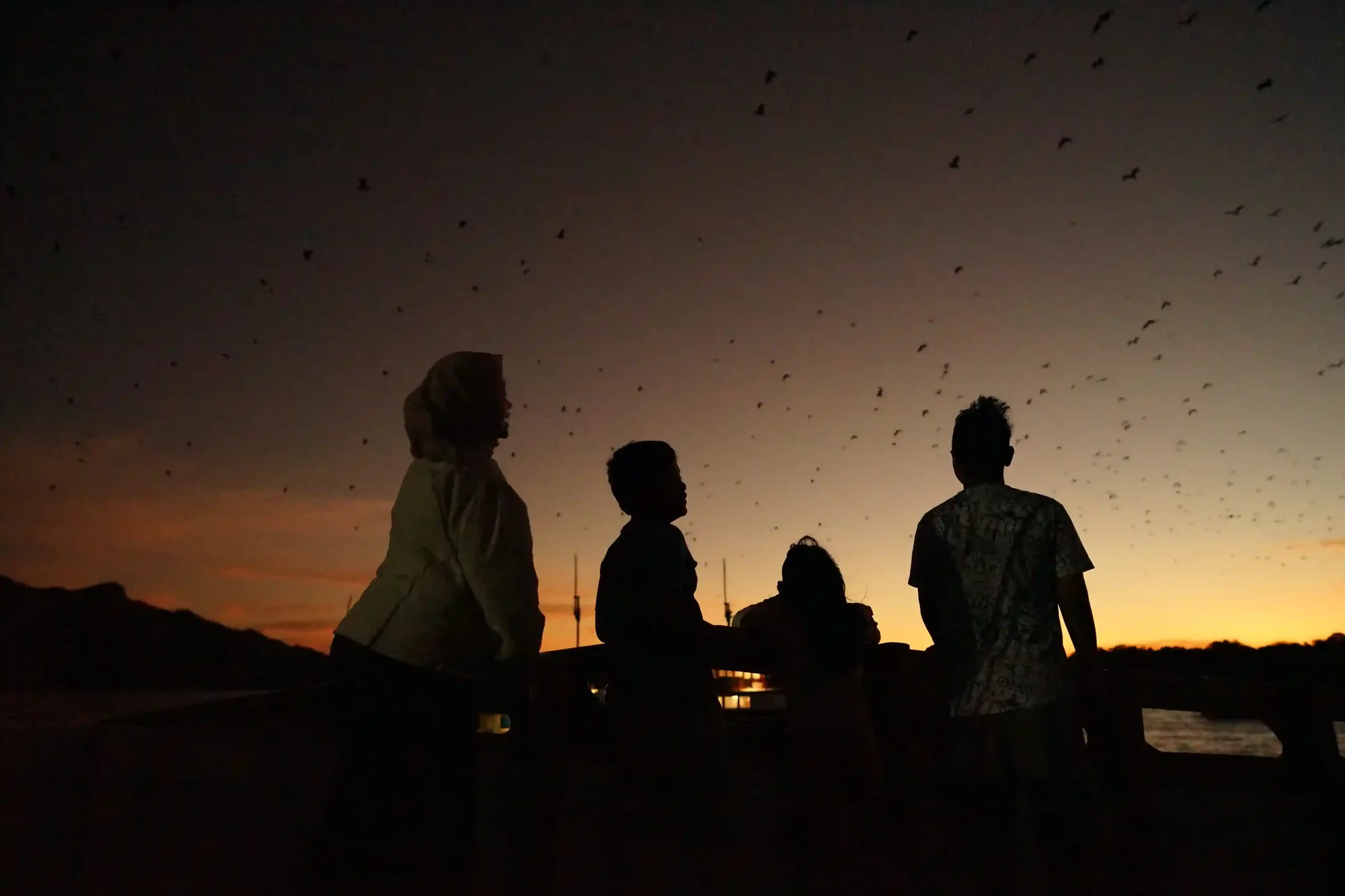
Kalong, which simply means bat in Indonesian, is a low mangrove island in the bay between Labuan Bajo and the outer islands. Large fruit bats, properly flying foxes, roost in the mangroves through the day. As the light goes, they wake, circle, and then leave in a continuous stream heading for the fruiting trees on Flores.
The exodus is not a single burst. It builds: a few, then dozens, then a river of animals crossing overhead for twenty minutes or more. Flying foxes are large, with wingspans typically over a metre, and they cross close enough that you hear the wings. Boats anchor offshore, because the mangroves are the roost and disturbing it would end the spectacle for everyone.
| Element | Detail |
|---|---|
| Position in the day | Late afternoon anchorage, around 16:30 on the published day-one route |
| When the bats leave | At dusk, as the light drops; timing moves with the season |
| Duration | Typically 20 minutes or more of continuous movement |
| Viewing position | From the boat’s deck at anchor, offshore from the mangroves |
| What follows | Dinner served on board while the boat stays at anchor |
| Accessible on a day trip? | Not realistically; day boats return to harbour before dusk |
Where to stand on a 34-metre boat
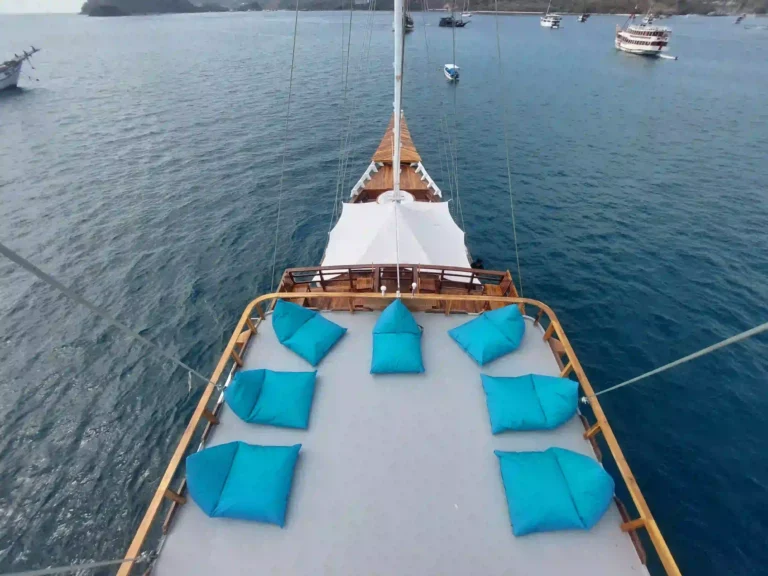
The sundeck, and higher is better. Two reasons: you get a clean horizon line without the rigging cutting through it, and you get the bats against sky rather than against the mangrove line, which is where they disappear visually. The bow works if the boat is lying the right way; ask a crew member which side the stream will pass, because they have watched it a hundred times and you have not.
The unglamorous advice: get up there ten minutes early and stay there. The moment the stream thickens is not the moment to be negotiating a ladder in fading light. On a large hull with a 6.3-metre beam there is enough sundeck for everyone to have a clear view, which is not true on smaller vessels where the good spots go fast. The deck layout is described on the vessel overview page.
Camera settings that actually work
This is a genuinely difficult exposure: moving subjects, low light, and a bright sky behind them. Phones will not do it. If you have a camera:
- Shoot at the widest aperture you have, and accept the shallow depth of field.
- Push ISO higher than feels comfortable. Noise is recoverable; motion blur is not.
- Shutter speed of 1/500 or faster if you want individual bats sharp; slower if you want the stream as a blur, which is often the better picture.
- Meter for the sky, not the bats. They will silhouette, and silhouettes are the shot.
- Manual focus set to infinity beats autofocus hunting in low contrast.
- Shoot wide as well as long. The scale of the stream is the story, not one animal.
And then put the camera down for the last five minutes. Every guide in Labuan Bajo will tell you the same thing, and every guest agrees afterwards.
Why is this a liveaboard-only stop?
Arithmetic. The bats leave at dusk. A day boat operating out of Labuan Bajo has to be back alongside before dark, which means leaving the anchorage before the event. An overnight boat anchors, watches, serves dinner and sleeps there. It is the same structural advantage that gives liveaboards the 06:00 Padar ridge the following morning, at the opposite end of the day.
On the published route, Kalong closes day one after Kelor and Manjarite, with dinner served at anchor and the boat repositioning overnight for the Padar sunrise. The full hour-by-hour sequence is on the 3D2N itinerary page, and even the shortest overnight option keeps it: the 2D1N private charter reaches Kalong on its single night.
Dinner at anchor
The practical rhythm of the evening is worth knowing. The boat anchors while it is still light, people swim or shower, the bats go over, and dinner follows on deck. All meals plus mineral water, coffee and tea are on the operator’s published inclusion list; alcohol and soft drinks are not, which is worth knowing before the first sunset rather than during it.
It is also the quietest anchorage of the trip. No engine, no generator load beyond the essentials, no other boats once the day fleet has gone home. For couples this tends to be the evening the trip is remembered for, which is why it anchors the route described on the honeymoon cruise page.
Wildlife, not a performance. Flying-fox numbers and the exact timing of the exodus vary with season, weather and fruiting cycles on Flores. Descriptions here reflect commonly documented behaviour reviewed 31 July 2026. Boats anchor offshore and do not approach the roost.
Wildlife-led itineraries generally reward a whole-boat booking, where the anchorage and the timing are yours; the operator publishes the operator’s Komodo dragon trekking notes alongside its other land-and-wildlife programmes.
Sailing with Lady Grace
Ask which anchorage your departure uses on night one and what time the crew expects the exodus for your dates.
WhatsApp +62 811 3823 875 · [email protected]
Lady Grace is operated by Komodo Luxury in Labuan Bajo. Quotes, availability, deposit terms and cancellation terms are issued by the operator in writing before payment.