
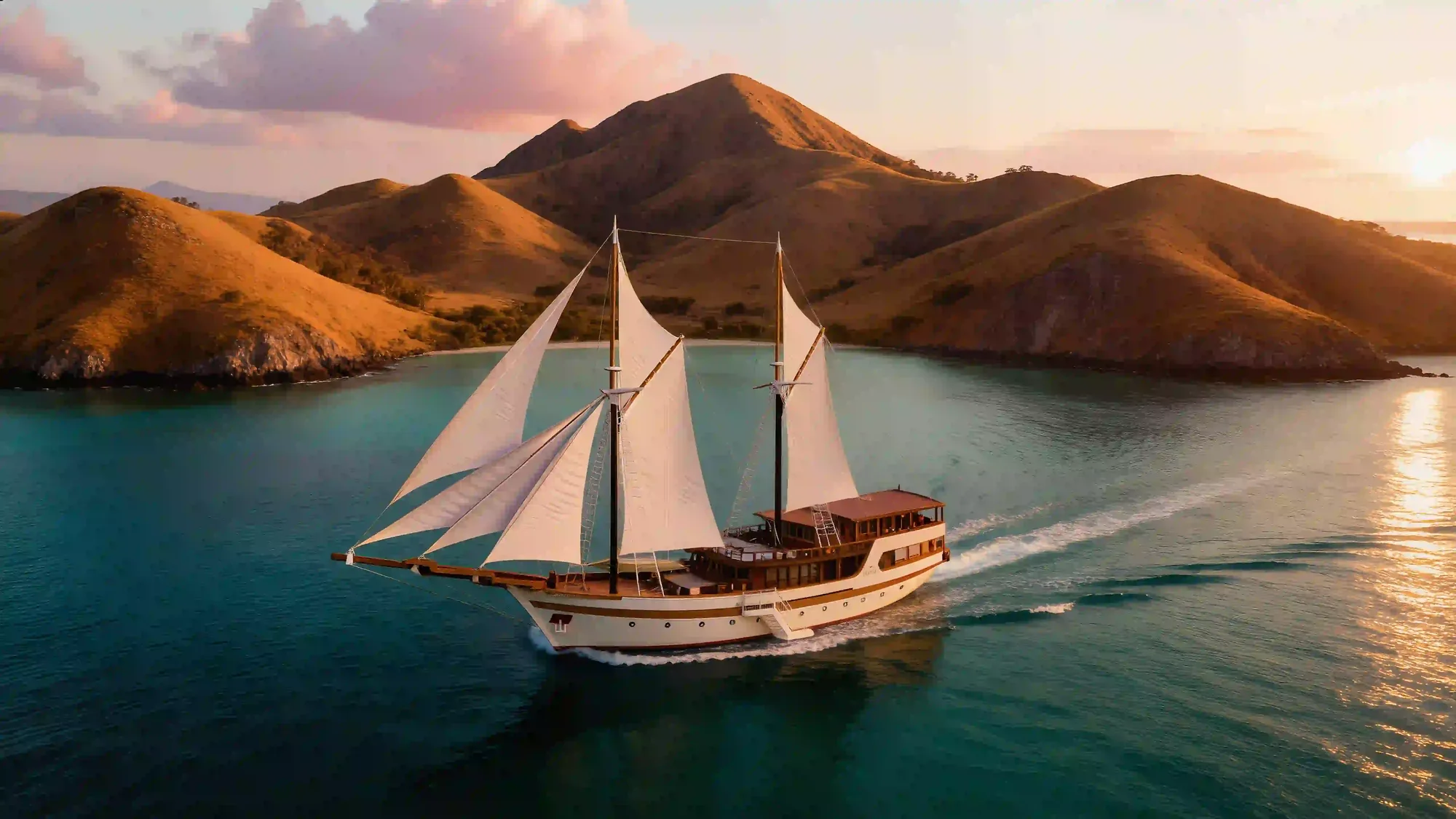
Short answer. Most of a Komodo itinerary runs inside sheltered channels between islands, where motion is mild. The movement you feel is on the open crossings between island groups, mainly on the outbound and return legs and in the monsoon months. A larger hull and a lower, midships cabin both reduce it materially.
Nobody wants to raise this before booking, and everybody thinks about it. Here is the unglamorous, practical version: where the movement actually comes from, what reduces it, and what to do if you are one of the people who suffers.
Is the Komodo route rough?
Mostly no. The great majority of a three-day itinerary is spent inside the island chain, moving between anchorages that are only an hour or two apart, in channels sheltered by land on both sides. Overnight you are at anchor, not underway. The picture people have of a constant ocean swell is not what this trip looks like.
What does move is the open water between island groups: the run out from Labuan Bajo on day one, the transit south and west toward Padar and Komodo, and the return leg. Those are the legs where a sensitive traveller notices it, and they are a modest fraction of the trip.
| Leg | Typical motion | When it is worse |
|---|---|---|
| Labuan Bajo to the near islands | Mild | Afternoon wind against tide |
| Near islands to Kalong anchorage | Mild, sheltered | Rarely an issue |
| Overnight at anchor | Gentle roll only | Exposed anchorages in monsoon swell |
| Transits between island groups | The most noticeable of the trip | December to March, and windy afternoons |
| Inside the park channels | Mild | Strong tidal flow can create chop |
| Return run to harbour | Mild to moderate | Afternoon; morning returns are calmer |
What does hull size change?
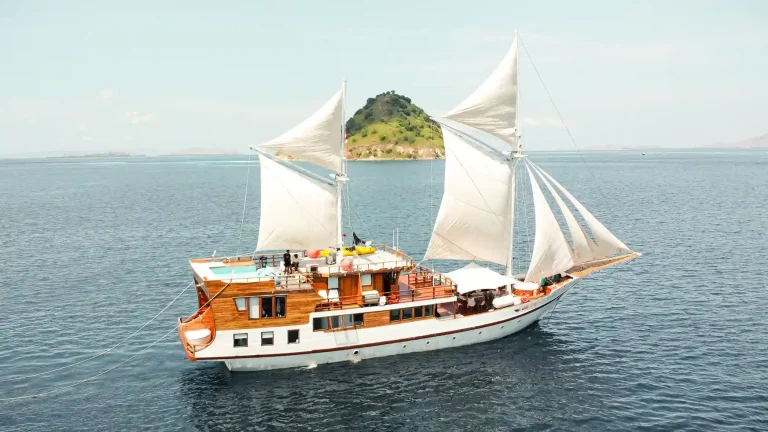
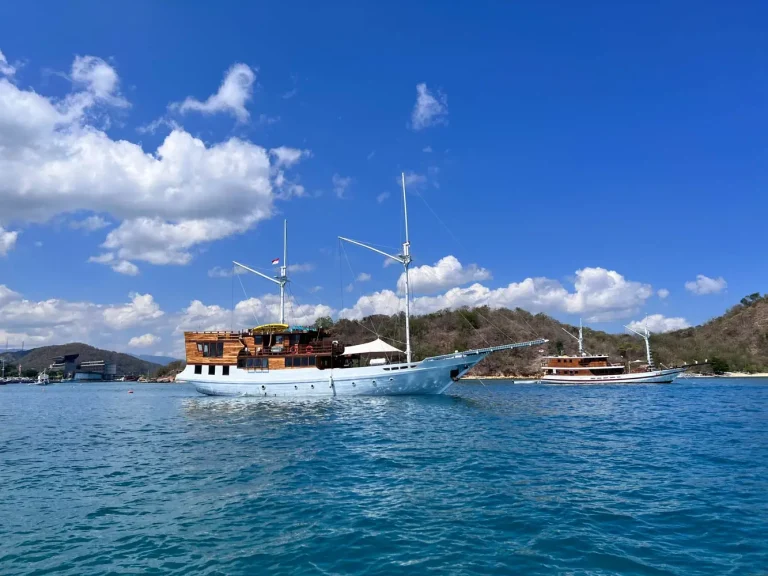
A great deal, and it is the most underrated reason to look at vessel dimensions. Motion in a seaway is a function of mass, length and beam. A 34-metre hull with a 6.3-metre beam has far more of all three than a converted day boat, so it rolls more slowly and pitches less through the same swell. Slow motion is dramatically easier on the inner ear than fast, snappy motion, which is why people who have been sick on a small boat are often fine on a large one.
Hull material contributes too: a heavy ironwood and teak hull carries more inertia than a light one. And a 6 to 9 knot cruising speed means the boat works with the sea rather than driving through it. Full specifications are on the vessel and charter page.
| Specification | Detail |
|---|---|
| Length overall | 34 m |
| Beam | 6.3 m |
| Hull and deck material | Ironwood and teak |
| Guest cabins | 10 |
| Guest capacity | 22-24 |
| Main engine | Mitsubishi 8M21 |
| Generators | Mitsubishi PS120 x 2 |
| Average cruising speed | 6-9 knots |
| Fuel capacity | 5 tonnes |
| Freshwater capacity | 12 tonnes |
| Navigation | AIS, GPS, Radar SART |
| Emergency communication | EPIRB |
Which cabin should a sensitive traveller book?
Lower and midships. This is genuinely the single most effective thing you can do, and it costs nothing. A boat pivots around its centre, so motion is smallest near the middle and closest to the waterline, and largest at the bow and on the upper deck.
There is an awkward trade-off here, because the best cabins are usually the upper-deck suites with balconies, and the calmest cabins are usually the lower ones with portholes. If someone in your party is genuinely motion-sensitive, a Deluxe on a lower deck may be a better night’s sleep than a Suite above it. Grade descriptions are on the cabin options page.
One honest caveat. The operator’s published specification lists a single bunk-bed Superior cabin while the cabin section lists two. If Superior berths matter to your group, ask the booking desk to confirm the exact count for your departure before you commit.
Which months are roughest?
December to March is the wet monsoon, with January and February heaviest, and that is when swell and wind are most likely to make a crossing uncomfortable. April to November is the dry season and June to September is the most settled water of the year. If a member of your party is badly affected by motion, the season is worth choosing deliberately rather than accepting whatever the calendar offers. The full picture is in the month-by-month sea guide.
Practical remedies that work
- Take medication before you sail, not after you feel it. Once nausea starts, oral remedies are far less effective.
- Stay on deck in fresh air with the horizon in view. Cabins and screens make it worse.
- Eat something plain. An empty stomach is not protective.
- Stay hydrated, and go easy on alcohol the night before a crossing.
- Lie down midships if it takes hold, on your back, eyes closed.
- Acupressure bands and ginger help some people and harm nobody; bring them if they have worked for you before.
Speak to a pharmacist or doctor about medication before you travel, particularly if you take anything else regularly. Do not take medical advice from a boat blog, including this one.
When does the crew reroute?
Routinely, and it is a good sign. Crews change the order of stops, choose a more sheltered anchorage or delay a crossing when conditions call for it. An itinerary that runs identically regardless of the sea is being operated by a timetable rather than a seaman.
If someone in your group struggles badly, tell the crew early rather than heroically enduring it. They deal with this every week, they know which anchorage is calmest, and they can often adjust. Group-booking arrangements where that flexibility matters most are described on the group charter page, and departure options across the wider fleet run through the operator’s group-booking desk.
General information, not medical advice. This page describes typical sea conditions on Komodo routes documented 31 July 2026 and general comfort measures. It is not medical advice. Consult a pharmacist or doctor about motion-sickness medication, especially alongside other prescriptions.
Sailing with Lady Grace
Tell the booking desk if anyone in your party is motion-sensitive, and ask which cabin position they would recommend.
WhatsApp +62 811 3823 875 · [email protected]
Lady Grace is operated by Komodo Luxury in Labuan Bajo. Quotes, availability, deposit terms and cancellation terms are issued by the operator in writing before payment.