
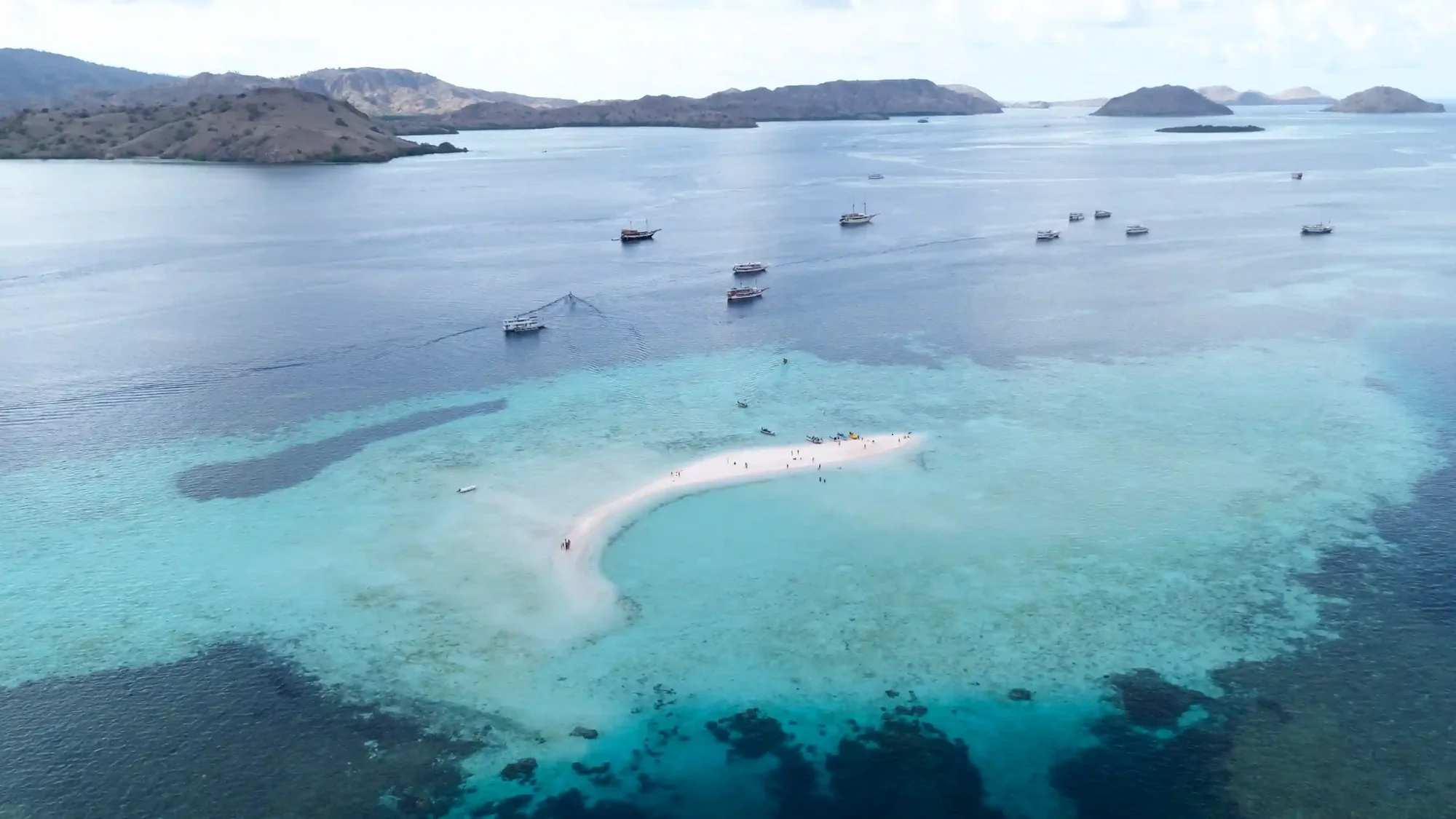
Short answer. Taka Makassar is a crescent-shaped sandbar that appears and shrinks with the tide, sitting close to the Karang Makassar manta channel. Siaba is a sheltered bay known for green turtles grazing on seagrass. Both are shallow, snorkel-friendly and usually sailed back to back with the manta stop.
These are the two stops that rarely make the headline and reliably make the trip. No dragons, no ridge climb, no queue: just a sandbar in the middle of the sea and a bay full of turtles. If you asked twenty returning guests which hour they would repeat, a surprising number choose one of these.
Taka Makassar: a sandbar that is not always there
Taka Makassar is not an island in any permanent sense. It is a low crescent of white coral sand sitting on a reef flat, and its size changes with the tide. At low water it is a generous curve you can walk end to end; at high water it can be a thin sliver or barely above the surface. That is why one visitor’s photograph shows a beach and another’s shows a line of sand with people standing in ankle-deep water, and both are accurate.
The colour is the reason it photographs so well. Shallow water over white sand gives that improbable graded turquoise, deepening to blue where the reef drops away. The reef edge itself is where the snorkelling is: coral, reef fish and, because you are minutes from Karang Makassar, the occasional manta passing through.
| Taka Makassar | Siaba | |
|---|---|---|
| Type | Sandbar on a reef flat | Sheltered bay with seagrass beds |
| Main draw | Colour, photography, reef-edge snorkelling | Green turtles grazing |
| Depth | Very shallow at the bar, dropping at the reef edge | Shallow to moderate |
| Current | Tide-dependent; can run at the edges | Generally gentler than the channel |
| Tide dependence | High. Size and access change through the day | Lower, but visibility varies |
| Typical slot | Day two, late afternoon | Day three, morning |
Siaba and the turtles
Siaba is a bay with seagrass beds, and seagrass is what green turtles eat. Sightings are frequent enough that the stop exists for that reason, though as with every wild animal they are not on a timetable. Turtles here are usually grazing on the bottom, rising to breathe every few minutes, which makes them straightforward to observe from the surface.
Turtle etiquette matters and is simple:
- Do not touch, ever. It stresses the animal and can damage the shell’s protective layer.
- Never block the route to the surface. A turtle that cannot ascend to breathe is in real trouble.
- Stay above and behind, not in front. Approaching head-on ends the encounter.
- Do not ride, hold or chase. It should not need saying and it still does.
- Keep fins off the seagrass; it is habitat, not scenery.
Snorkelling gear and life vests are on the operator’s published inclusion list, and the crew brief covers where to enter and where the current sets. The wider water programme is set out on the diving and snorkelling liveaboard page.
Equipment, stated plainly. The operator’s published inclusion list for Lady Grace covers snorkelling gear and life vests. It does not list tanks, a compressor, weights, a dive deck or on-board dive guides. Treat Lady Grace as a snorkelling-first liveaboard and arrange certified diving separately through a licensed Labuan Bajo dive centre, clearing the logistics with the booking desk first.
Why the tide decides everything
Both stops are tide-sensitive in different ways. Taka Makassar’s usable area is directly a function of water height, and the current at the reef edge runs harder around the tidal peaks. Siaba’s visibility and the ease of the swim both improve on a gentler flow.
This is why the crew reorders stops. If the timetable says Taka Makassar at 16:30 and the tide says otherwise, the tide wins. Take that as a sign of competence rather than disorganisation: an itinerary that never changes is being run by a clock rather than by the sea. The published order and timings are on the 3D2N itinerary page.
Why you need an overnight boat
Both sites sit deep in the park, well past the point a day boat can reach, work and return from in daylight. Day trips out of Labuan Bajo that include Taka Makassar do it as a rushed photo stop; a liveaboard already anchored in the area arrives when the tide is right and stays as long as it is worth staying.
The same logic applies to Siaba on the final morning. On the published route it is the last snorkel before the run back to harbour, at around 08:00 on day three, which is early enough that the water is still glassy. A day boat is not in that part of the park at that hour.
Sandbars move, wildlife does not book. Taka Makassar’s shape and exposed area change with tide and season, and turtle sightings at Siaba are frequent but never guaranteed. Descriptions here reflect commonly documented conditions reviewed 31 July 2026.
Practical notes
- There is no shade on the sandbar. Hat, shirt and reef-safe sunscreen, applied before you get in the tender.
- Nothing on Taka Makassar is a bin. Everything you carry ashore comes back with you.
- Footwear helps at the reef edge; coral rubble is unkind to bare feet.
- For photographs, shoot from the tender on approach as well as from the sand. The crescent only reads as a crescent from above the water.
- Do not stand on coral to get the shot. The reef flat is alive.
Groups who want long, unhurried water time rather than a fixed stop list generally do better on a whole-boat booking, described on the private phinisi charter page. Concierge support for special requests around these anchorages runs through the group’s Labuan Bajo concierge.
Sailing with Lady Grace
Ask how your departure’s tide window falls on day two, and whether Taka Makassar and Siaba are scheduled around it.
WhatsApp +62 811 3823 875 · [email protected]
Lady Grace is operated by Komodo Luxury in Labuan Bajo. Quotes, availability, deposit terms and cancellation terms are issued by the operator in writing before payment.