
Short answer. April to November is the dry season, and June to September is the most settled water of the year with visibility around 20 to 30 metres. December to March is the wet monsoon, with January and February heaviest, but it is also the peak window for manta rays at Karang Makassar.
Komodo has no bad month, only trade-offs. The calmest seas come with the highest prices and the fullest anchorages. The best manta encounters come with rain, swell and cloudy water. Understanding which trade-off you care about is more useful than chasing a single best month, so this guide sets out all twelve.
The twelve-month picture
| Month | Sea and weather | Typical visibility | What it means on the water |
|---|---|---|---|
| January | Wet, heaviest rain | 10-15 m | Peak manta season at Karang Makassar |
| February | Wet, heaviest rain | 10-15 m | Peak manta season, routes adjusted for swell |
| March | Wet, easing | 10-15 m | End of the peak manta window |
| April | Dry season begins | 20-30 m | Seas settling, fewer boats |
| May | Dry | 20-30 m | Strong manta sightings with better visibility |
| June | Dry, most settled | 20-30 m | Prime conditions, calendars fill early |
| July | Dry, most settled | 20-30 m | Peak demand, south Komodo cools to 24-26 C |
| August | Dry, most settled | 20-30 m | Peak demand, upwelling continues in the south |
| September | Dry, most settled | 20-30 m | Prime conditions, demand eases late in the month |
| October | Dry | 20-30 m | Warm, calm, good value |
| November | Dry season ends | 20-30 m | Transitional, still widely sailed |
| December | Wet begins | 10-15 m | Manta numbers rising, holiday demand high |
What actually changes between wet and dry?
Three things move together. Wind and swell rise in the monsoon, which matters most on the open crossings between island groups rather than inside the sheltered channels. Visibility drops from a typical 20 to 30 metres in the dry season to roughly 10 to 15 metres in the wet, because the same plankton bloom that clouds the water is what brings the animals in. And water temperature sits at a comfortable 26 to 29 degrees most of the year, with a cooler 24 to 26 degrees in south Komodo during the July to September upwelling.
That upwelling is why experienced visitors pack a thin wetsuit or rash guard even in August. The air is hot, the northern sites are warm, and then you drop into the south and find it noticeably cooler.
When are the mantas?
Reef mantas are present at Karang Makassar all year. What changes is density. The peak aggregation runs roughly December to March, when plankton concentrations are highest, which is exactly when visibility is at its worst. Divers and snorkellers who care most about numbers accept the murkier water; those who care about photography usually prefer the shoulder months of April, May, October and November, when there is still good manta activity with clearer conditions. The dedicated guide to snorkelling at Manta Point covers how the drift itself works.
Do boats stop sailing in January and February?
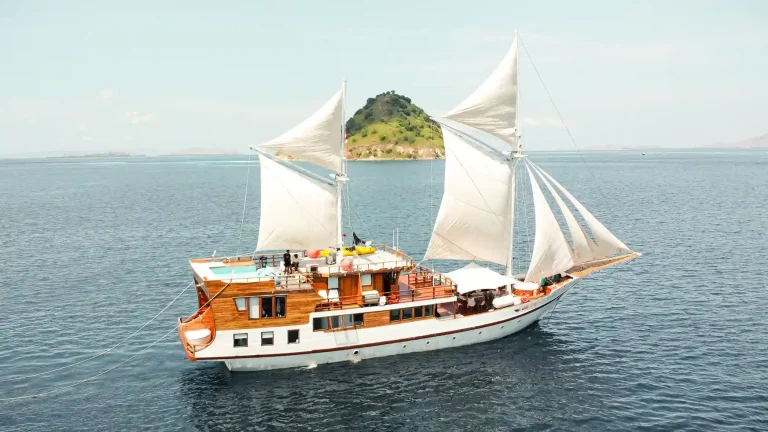
Some do. Small wooden day-boat conversions and open-deck vessels frequently pause or reduce their schedule in the heaviest weeks of the monsoon, because their hulls and their guests are not comfortable in that swell. A 34-metre phinisi with a 6.3-metre beam is a different proposition: more mass, more freeboard, and a crew that reroutes to sheltered anchorages rather than cancelling. Lady Grace’s published 2026 calendar shows weekly departures in every month of the year, typically as Friday-to-Sunday three-day blocks.
That does not mean the sea is flat in February. It means the vessel and the itinerary have the flexibility to work around it. Expect the crew to change the order of stops, and expect them to be right about it.
Which month suits which traveller?
| You are | Best window | Why |
|---|---|---|
| A photographer | May, June, September, October | Clear water, settled light, fewer boats in frame at the popular viewpoints |
| Chasing mantas | December to March | Peak aggregation at Karang Makassar, accepting 10-15 m visibility |
| Travelling with children | April, May, October, November | Calm water, warm air, shoulder-season pricing and quieter anchorages |
| On honeymoon | May, June, September | Settled seas for balcony and sundeck time, sunsets uninterrupted by squalls |
| Budget-conscious | February, March, November | Lowest demand across the Labuan Bajo fleet |
| Locked to school holidays | July, August | Book six to nine months ahead; this is the tightest availability of the year |
The booking calendar matters more than the weather
For June through September, the constraint is rarely the sea. It is availability. Peak-season cabins on the larger phinisi are committed months in advance, and the suites go first. If your dates are fixed by school holidays or annual leave, treat the calendar as the binding limit and work backwards from it. The sailing schedule and availability page explains the departure pattern and what to confirm in writing.
Shoulder months reward flexibility. October in particular is warm, settled and noticeably quieter than August, and it rarely appears on the lists of best months that circulate online. For a view of how the wider fleet’s calendar fills across the same season, the operating company publishes the operator’s dive and snorkel programmes alongside its sailing dates.
One more scheduling note that catches people out: the standard Labuan Bajo pattern is a Friday-to-Sunday three-day block, which means the popular anchorages hold more boats at the weekend than midweek in every month of the year. If your dates are flexible by two days, a midweek departure buys you a quieter Padar ridge and a quieter Pink Beach than any change of season will. The published route and timings are on the 3D2N itinerary page.
What to pack for the season you choose
- Dry season, June to September: rash guard for the cooler southern sites, high-factor reef-safe sunscreen, a hat that survives 9 knots of apparent wind.
- Wet season, December to March: a genuinely waterproof drybag, a light rain shell, and an extra change of clothes for the tender rides.
- All year: motion-sickness remedies for the crossings, a power bank, and hiking sandals with grip for the Padar and Kelor climbs.
Conditions, not guarantees. Weather patterns, visibility ranges and manta density above are documented seasonal norms for the park, gathered 31 July 2026. They are not forecasts. Any individual week can behave differently, and the crew’s judgement on the day overrides any calendar.
Sailing with Lady Grace
Tell the booking desk your dates and what you most want to see, and ask which departures still have the cabin grade you want.
WhatsApp +62 811 3823 875 · [email protected]
Lady Grace is operated by Komodo Luxury in Labuan Bajo. Quotes, availability, deposit terms and cancellation terms are issued by the operator in writing before payment.